
Student’s Unique Project: Accurate Mapping of Surface Water Resources Using NDWI and Machine Learning
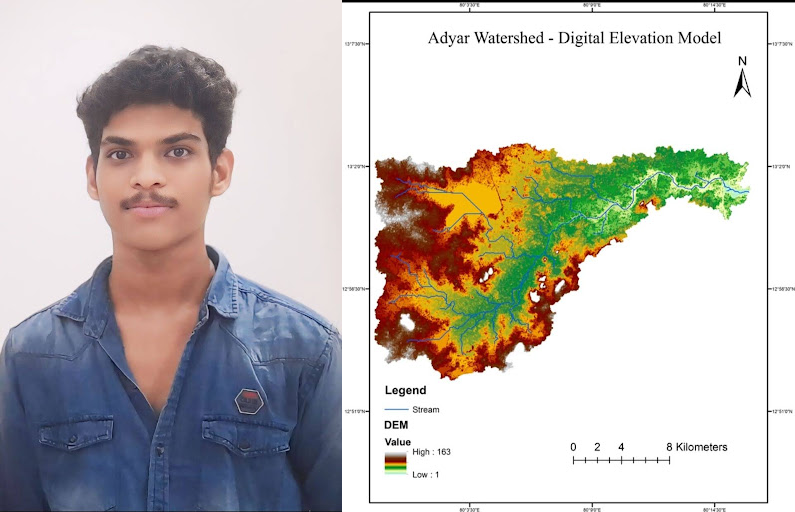
Daulatabad: Tumu Srijenith, a B.E. Mechatronics Engineering student at Satyabhama Institute of Science and Technology, has presented an innovative project titled “AI-Assisted Surface Water Body Extraction using NDWI and Machine Learning from Satellite Imagery.” During this 45-day online program, the student used satellite imagery and Artificial Intelligence (AI) techniques to identify and map surface water bodies.
The main goal of the project was to accurately identify surface water sources and measure their area. For this, the Normalized Difference Water Index (NDWI) was used, which measures the difference in reflectance between the green and near-infrared (NIR) bands. NDWI makes it easier to separate water bodies from other land features.
Tumu Srijenith applied AI-based threshold optimization and spatial filtering techniques, keeping in mind the limitations of traditional threshold-based methods. This approach significantly reduced errors caused by vegetation, shadows, and built-up areas.
Key Project Details
The project focused on Chilika Lake in Odisha, India’s largest coastal lagoon, which spreads across Puri, Khordha, and Ganjam districts. Studying this area is important because the lake’s wide water spread and seasonal variations make it ideal for accurate surface water mapping.
Sentinel-2 satellite imagery was used for the study. After importing the imagery into QGIS, an NDWI raster was created, making it easy to distinguish water and non-water areas. Then, histogram-based thresholding and neighborhood filtering were used to prepare a binary water mask, ensuring precise classification of water and land areas. The final maps and area data were verified using high-resolution imagery from Google Earth Pro, increasing the reliability and accuracy of the results.
The study successfully mapped water bodies over approximately 1100 square kilometers of Chilika Lake. Using spatial filtering helped reduce small classification errors significantly.
This project is important for many areas. It can be used for water source monitoring, flood early warning systems, drought assessment, tracking reservoir capacity, aquatic life conservation, climate change analysis, and urban water resource planning. Its efficiency and scalability make it effective for regional and national water resource management.
In conclusion, the combination of NDWI and AI-based techniques proved effective for accurate mapping of surface water bodies. Compared to traditional methods, it provides more reliable and precise results. In the future, adding multi-temporal analysis and deep learning techniques could make it even more advanced.